Lycopodium powder is the best-kept secret behind an unforgettable fireball moment for many performers. It's a fine, yellow-brown powder that you scatter through the air as a mist, pass through a flame, and in a fraction of a second it translates into a large, warm ball of fire. No pyrotechnics, no synthetic additives, no complex chemistry. Just the dried spores of a plant.
In this guide we cover everything: what lycopodium actually is, how we use it on stage, how to work with the powder safely, and how to store it correctly. Finally, we explain where to find quality powder and answer the questions we get most often.
What is lycopodium powder?
Lycopodium powder consists of the dried spores of the club moss plant (Lycopodium clavatum), a low, creeping plant that grows in forests across the northern hemisphere. It's a 100% natural product with no chemical additives.
What makes it so special for stage use is the structure of the spore itself. Each spore has a high fat content, which makes it especially flammable as soon as there is enough oxygen between the particles. In bulk, packed together in a jar, nothing happens. Dispersed in the air, an explosive mixture suddenly forms.
Depending on the sieving technique, you get different grain sizes. In practice we speak of light and heavy lycopodium. The light powder contains larger spores that sit less densely together, which means more oxygen between the particles and therefore a fuller, more voluptuous flame. In our webshop we sell light lycopodium as standard, because it gives the best result for most stage applications.
Historically, lycopodium was also used as flash powder in early photography and as a powder in old apothecaries. A raw material with a rich past in both visual and theatrical arts.
How do performers use lycopodium?
The working principle is always the same: air dispersion. You scatter the powder so the spores spread through the air, with enough oxygen between the particles to allow continuous combustion. When that mist meets a flame, the whole cloud ignites at once. Outside that mist, in a jar or on the ground, the powder is not flammable.
In a typical set-up, we transfer the powder into a torch or a dedicated dispenser system. A fast dispenser, like the system we offer in our webshop, gives you far more control over quantity and spread than an open container. Then a flame source is prepared, often a torch dipped in lamp oil. Important: the powder must stay dry. Once damp, it clumps and loses its effect.
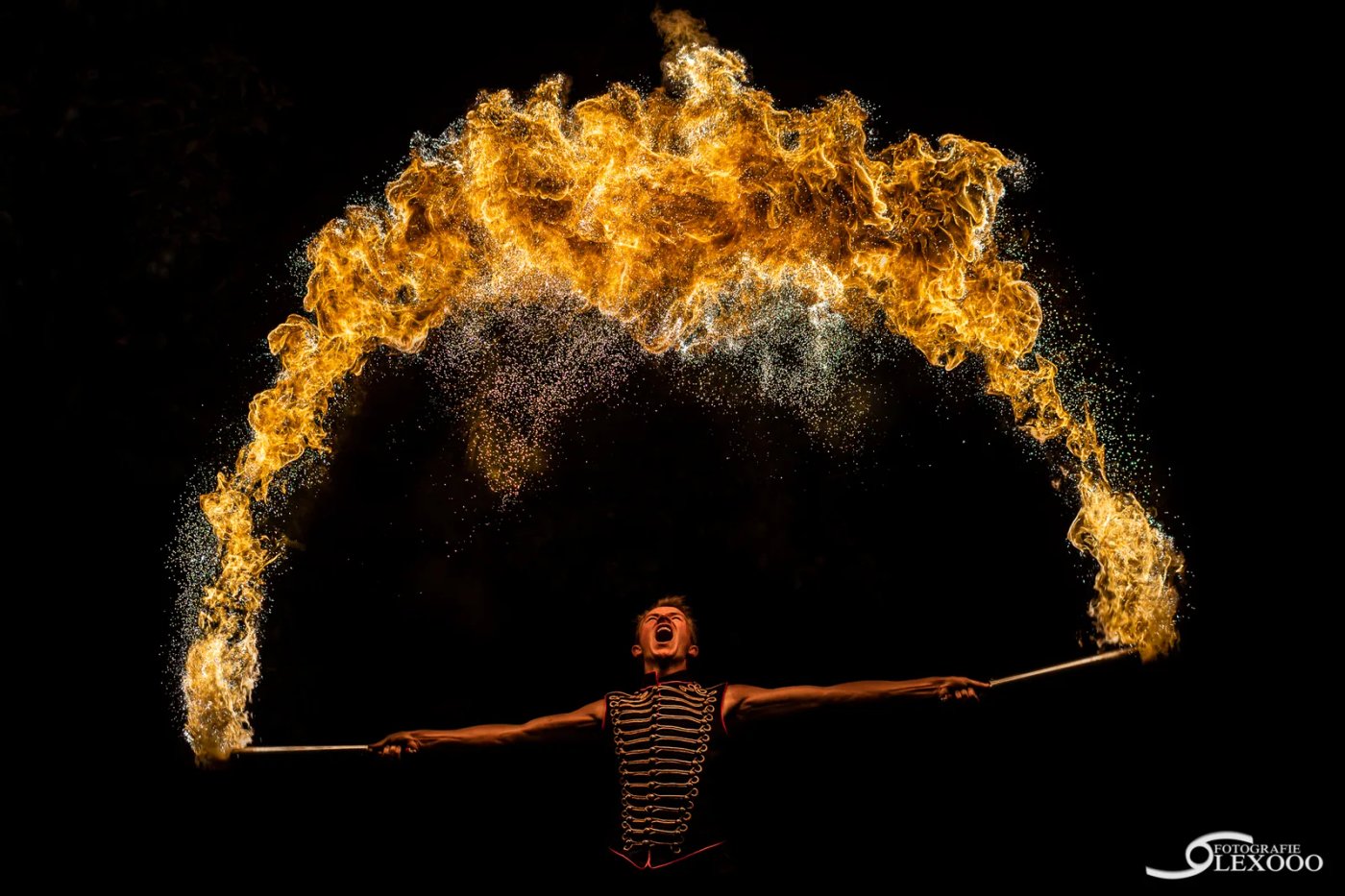
During performance, you light the torch and scatter the powder through the flame in a flowing motion. Some performers spin the torch so the powder is released around the flame and ignites there. The result is a large, warm fireball that lasts a few seconds and always makes a visual impact, both live and on camera.
The applications are wide-ranging: fire performance at events and festivals, theatre and opera productions, music videos, photoshoots, illusionism and special effects. For many of our peers we have become the go-to Belgian address, not only for what we do on stage, but also for what we supply through our webshop.
A major advantage: in most countries lycopodium is not classified as a pyrotechnic product. That makes it much easier to integrate into productions than classic pyro. That said, every country has its own rules. Always check what applies in your region or at your venue.
Safety in use
Lycopodium is natural and non-toxic, but that doesn't make it harmless. A fireball is still a fireball. A few hard rules we strictly follow ourselves:
Heat and clothing
Ignition produces a great deal of heat in a very short time. Make sure everything within reach is heat-resistant: costume, gloves, set, curtains and props. Never work with bare skin in the immediate vicinity of the ignition point.
Flame direction and wind
The flame rises strongly and is highly sensitive to wind. Outdoors, check the wind direction before every ignition. Never ignite lycopodium directly under your head or under a low ceiling, a tent canvas or any other flammable material.
Inhalation
These are extremely small particles. Inhaled in large quantities, they can be harmful to the lungs. When transferring powder into a torch or dispenser, wear a face mask and work in a ventilated space.
No build-up
Never scatter so much powder that a layer builds up on the ground or a prop. A build-up can ignite unexpectedly when combined with a spark. Work in thin, spread-out quantities.
Open fire and storage
In the space where you store or refill the powder, no candles or burning torches. Fill the powder first, then light fire only in a separate area. Always keep an extinguisher within reach.
Good news: lycopodium is not harmful to the environment or to groundwater. Residue on grass or floor causes no ecological issue.
Lycopodium storage
Good storage decides whether your powder still works in six months the way it did on day one. Lycopodium is highly moisture-sensitive, and once it absorbs moisture, it clumps and loses its ignition properties.
Store the powder in a dry space with good ventilation and without extreme temperatures. Avoid cellars that condense in summer, garages where the temperature swings sharply, and spots right next to a radiator. Seal the container completely after every use.
Always keep lycopodium out of reach of children and don't place the containers near flammable liquids or open flame holders. If you work with larger quantities, split them across several smaller containers.